In France, thermal regulations impose strict requirements on building materials, but terracotta brick maintains its place thanks to a unique combination of performance and durability. Unlike other materials, brick must undergo firing at very high temperatures, a necessary step that directly influences its mechanical properties.
Some clays, though considered unsuitable, are sometimes used after precise mixing or specific additions, revealing the diversity of industrial methods. Behind each brick, technical choices and constant adjustments respond to evolving standards and ecological imperatives.
What are terracotta bricks made of? Composition and material choices
If we look into the manufacturing and composition of bricks, it all starts with the transformation of clay soil into a robust material, ready to withstand time and use. This expertise, widely spread across the Hexagon, favors local resources, extracted from a short distance from production sites. The choice of clay, its concentration in silica, the fineness of the grain, and the amount of iron oxides influence the shade obtained, from bright red to deep brown, while conditioning the strength of the brick once fired.
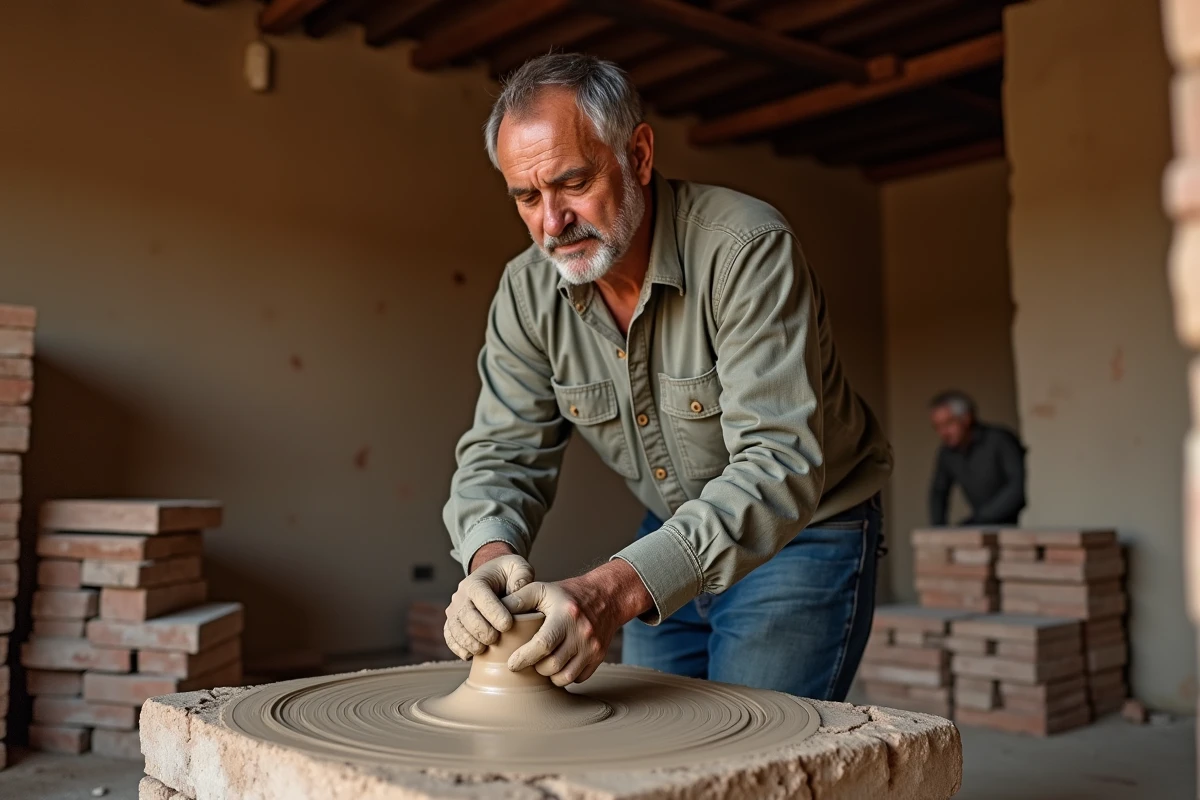
Before achieving this strength, the raw material goes through a series of meticulous operations. After extraction, the clay is carefully kneaded; sometimes, sand or natural de-agglomerants are added to achieve a more homogeneous texture and prevent the brick from cracking during drying. Depending on the region and local constraints, some manufacturers still adapt the recipe by incorporating specific ingredients, so that the brick meets climatic or acoustic requirements, or optimizes thermal insulation.
The variety of building materials used throughout France can be explained by this constant adaptation to regional particularities. In the manufacturing and composition of bricks, every decision, from the selection of the first clay to the chosen production site, affects the quality of the construction, the energy performance of the building, and the longevity of the work. Today, raw brick, without firing, stemming from ancient traditions, shares the stage with fired brick, symbolizing a balance between modernity, preservation of local resources, and harmonious integration into the landscape.
The behind-the-scenes of manufacturing: key steps and secrets of brickworks
The manufacturing of bricks relies on a succession of precise steps, where each action is part of a chain inherited from generation to generation. It all starts with the extraction of clay, usually in close proximity to the brickworks to limit unnecessary transport. The clay is then crushed, moistened just right, and kneaded to form a uniform paste, free from impurities.
What makes the difference? The accuracy of the dosages and the mastery of drying. If drying is rushed, the bricks crack or warp; if it is too slow, production stalls and costs rise. During molding, two main families of bricks emerge: the panneresse, laid on its width, and the boutisse, elongated in the length direction, two emblematic forms of French built heritage. Then comes the drying, sometimes sheltered, sometimes outdoors, which stretches over several weeks to ensure a gradual evaporation of moisture.
The firing marks the peak of the process. Contemporary kilns, inspired by ancient wood-fired models, exceed 1000°C, a temperature that forges the brick’s resistance and fixes its final color, dictated by the composition of the clay. Sometimes, the addition of hydraulic lime, a legacy of ancestral methods, reinforces the strength and longevity of the brick. From one region to another, the know-how, recipes, and firing times evolve, giving birth to a palette of bricks suited to each use, each constraint, and each particularity of the heritage.
Why does terracotta brick still appeal today? Ecological advantages and avenues for further development
The terracotta brick continues to make its mark on French constructions, whether in the capital or in the heart of the regions. It shapes a vibrant built landscape, resistant to fleeting trends as well as regulatory changes. What sets it apart: a natural composition and a local grounding. The clay used to make it often comes from the immediate surroundings, which significantly reduces the environmental impact related to transport and highlights the resources of the territory.
Architects and craftsmen favor terracotta for its qualities of thermal inertia. Integrated into a wall, it helps maintain a stable temperature, limiting the need for heating or air conditioning and promoting a rational management of energy. Its longevity is remarkable: a well-fired brick can last for decades, be reused or recycled without losing its technical properties.
Here are some concrete advantages that explain the enthusiasm for terracotta brick:
- Abundant resource: clay is available and allows for the production of materials accessible to all.
- Sober process: extraction, preparation, firing, each step is optimized to generate little waste and limit energy consumption.
- Controlled end of life: the brick easily integrates into the reuse circuit, ready to serve in new projects.
New avenues are emerging, particularly with air-dried raw brick, an alternative that is gaining ground. Less energy-intensive as it avoids firing, it preserves the philosophy of a healthy, local material designed to last. Driven by innovation and regional production dynamics, these solutions shape the face of more responsible construction, rooted in the richness of French soils.
In the choice of materials, terracotta brick stands as a benchmark: both a guarantee of solidity, respect for the territory, and sobriety, it continues to inspire those who build for tomorrow.