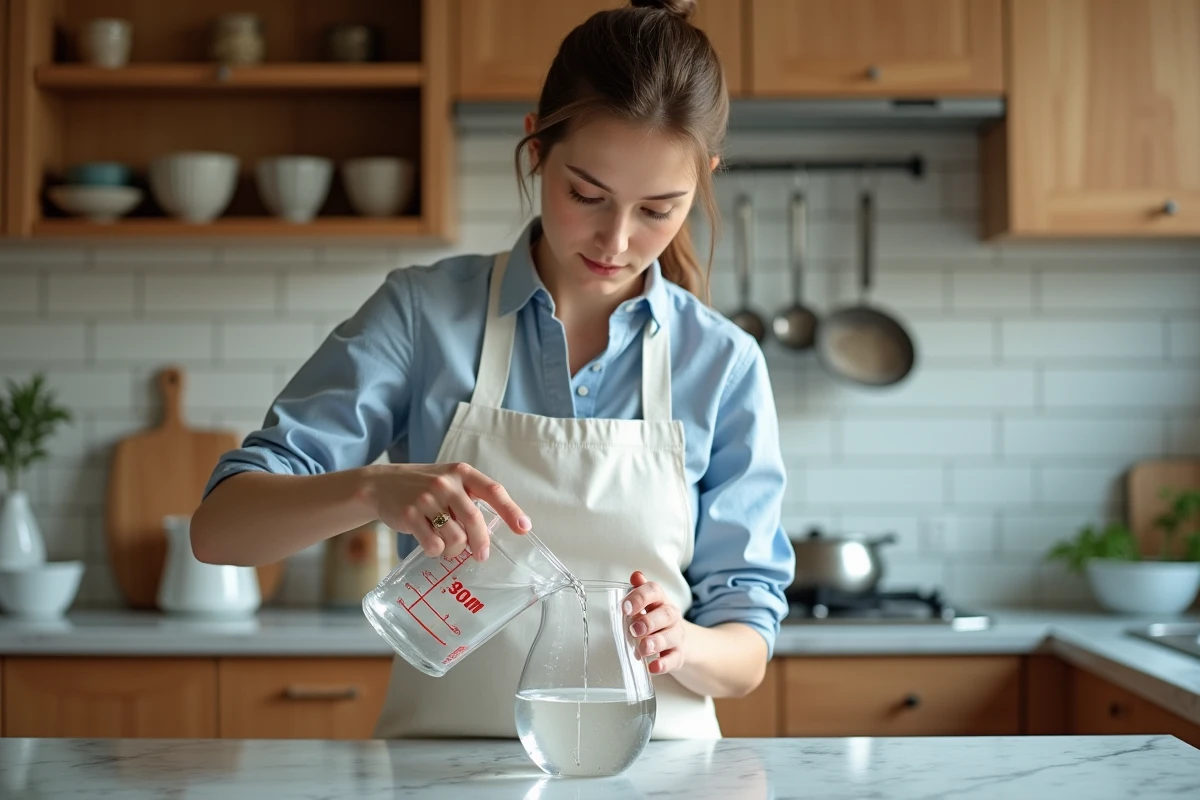
400 ml corresponds to 0.4 liters, the result of a division by 1,000. The formula is straightforward, but its application in real conditions poses problems that most conversion guides overlook, especially when the liquid measured is not water.
Density and volumetric conversion: why 400 ml does not always weigh 400 g
The relationship 1 ml = 1 g only holds for pure water at room temperature. As soon as you handle a liquid whose density deviates from 1, the volume remains the same (0.4 L) but the mass changes. This is where dosage errors occur in cooking and pharmacy.
Olive oil has a density close to 0.92. Pouring 400 ml of oil into a container yields about 368 g, not 400 g. Honey, on the other hand, has a density close to 1.4: 400 ml of honey weighs significantly more than 400 ml of water.
In professional pastry, volumetric conversions are adjusted to compensate for the viscosity of ingredients like cream or glucose syrup, a practice standardized by the Culinary Academy of France in its guide published in October 2025. Public tutorials that state “400 ml = 0.4 L, end of story” miss this distinction.
We recommend weighing rather than measuring by volume for any viscous ingredient. The conversion of 400 ml to liters remains valid volumetrically, but the accuracy of a recipe depends on switching to grams as soon as the density deviates from 1.

Calculation method ml to liter: division by 1,000 and its practical variants
The metric system is based on powers of 10. Converting milliliters to liters involves moving the decimal point three places to the left. For 400 ml: 400.0 becomes 0.400, or 0.4 L.
Three ways to achieve the same result
- Direct division: 400 ÷ 1,000 = 0.4 L. The most reliable method, applicable to any value in milliliters.
- Converting to centiliters: 400 ml = 40 cl, then 40 cl ÷ 100 = 0.4 L. This intermediate step helps with mental verification, especially in cooking where centiliters are common on packaging.
- Simple fraction: 400 ml represents 4/10 of a liter, or two-fifths. Visualizing 400 ml as 2/5 of a one-liter bottle makes it easier to estimate when a graduated glass is not available.
The most common source of error remains the misplacement of a decimal point. Writing 4.0 L instead of 0.4 L multiplies the quantity by ten, a confusion that has measurable consequences in pharmaceutical dispensing.
Measurement errors in pharmacies
The AFIPharma study “Measurement Errors in Pharmacies,” published in February 2026, reports frequent confusion between ml and L when dispensing liquid medications. This situation has led to a significant increase in internal training in pharmacies since 2025. A factor of 10 error in medication dosing is not trivial.
Conversion table ml, cl, dl and liter around 400 ml
A table is better than a long explanation when it comes to quickly checking an equivalence. We have concentrated the most useful values around 400 ml.
| Milliliters (ml) | Centiliters (cl) | Deciliters (dl) | Liters (L) |
|---|---|---|---|
| 100 | 10 | 1 | 0.1 |
| 200 | 20 | 2 | 0.2 |
| 250 | 25 | 2.5 | 0.25 |
| 300 | 30 | 3 | 0.3 |
| 400 | 40 | 4 | 0.4 |
| 500 | 50 | 5 | 0.5 |
| 750 | 75 | 7.5 | 0.75 |
| 1,000 | 100 | 10 | 1 |
The values 250 ml and 750 ml often appear in pastry recipes. Keeping these references in mind avoids having to pull out the calculator at every step.
Accuracy of measuring tools: which utensil for 400 ml
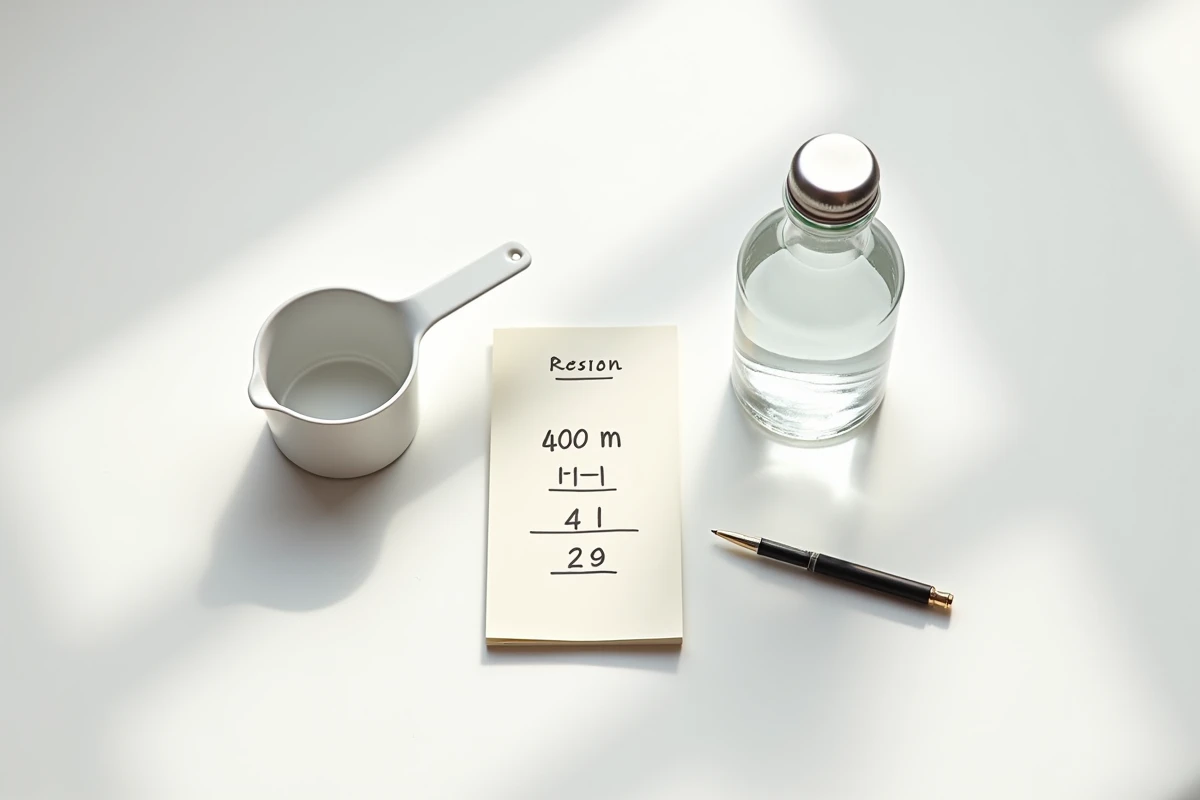
The conversion formula is useless if the measuring tool itself introduces an error. A cheap plastic measuring cup can deviate by several milliliters compared to a borosilicate glass model graduated by laser.
- Graduated glass measuring cup: accuracy within a milliliter, reading at the meniscus. Prefer engraved graduations over printed ones, as ink wears off with washing.
- Kitchen scale (tare mode): for non-aqueous liquids, weighing in grams gives a more reliable result than volume. Simply multiply the desired volume by the density of the liquid.
- Measuring syringe (pharmacy): for small volumes derived from 400 ml (for example, dividing into doses of 40 ml), the syringe offers superior accuracy to a tablespoon.
In cooking, precision to the nearest milliliter is not always necessary for a broth or sauce. However, in pastry and pharmacy, a deviation of a few milliliters alters the final result.
Convert 400 ml to liters in a recipe context: volume or mass
When a recipe states “400 ml of liquid cream,” two interpretations coexist. The first is purely volumetric: pour up to the 400 ml mark. The second takes mass into account, because 35% fat cream has a slightly lower density than 1.
For water, skim milk, or vinegar, the difference is negligible. For heavy cream, maple syrup, or honey, we observe a discrepancy that can reach several tens of grams over 400 ml.
The practical rule: if the recipe comes from a professional context (bakery, laboratory), the quantities are almost always expressed in grams. If it is expressed in milliliters, the author assumes a liquid close to water. Adapting the measurement to the nature of the liquid remains the only way to achieve a reproducible result.
The conversion of 400 ml to liters involves a simple arithmetic operation. The real difficulty begins when the liquid is not water and the precision of the dosage determines the outcome, whether it be a cake, a medicinal syrup, or an emulsified vinaigrette.