Transforming an interior no longer relies on a simple change of wall color or the addition of cushions. The trendy decor tips that make a difference are based on precise technical choices: dual-function materials, modular furniture, and acoustic treatment integrated into the decor. We have selected ten concrete ideas, each usable independently, to rethink your interior with a real impact on usage and ambiance.
1. Raw earth plaster on a load-bearing wall in the living room
Raw earth plaster offers an irregular texture and natural shades that are impossible to reproduce with conventional paint. Applied to a load-bearing wall or a partition wall, it adds visual depth that smooth finishes do not allow.
Beyond aesthetics, raw earth helps to regulate ambient humidity in living spaces. This is an asset in older homes where condensation problems persist. We recommend reserving this finish for one wall per room to avoid a monolithic effect and preserve contrast with more neutral surfaces.
To explore other complementary decorative approaches, the decor page on incroyablemaison.com lists material and style combinations suitable for this type of choice.
2. Multifunctional furniture for remote workspaces
Modularity is no longer a gimmick: it structures the design of small urban homes. A foldable desk integrated into an entry console, a lift-top coffee table that becomes a work surface, a storage bench that serves as seating and storage—these pieces absorb multiple functions without multiplying the occupied square meters.
Multifunctional furniture redefines the use of a room without heavy intervention. The technical selection criterion to check: the quality of the mechanisms (hinges, gas lifts, slides). A cheap gas lift wears out in just a few months of daily use.
3. Identical floor-wall covering to unify a volume
Extending the same covering from the floor to a wall (or even up to the ceiling in a bathroom) visually erases the edges of the room. The result: a volume perceived as larger and more coherent. This technique works particularly well with large-format tiles, polished concrete, or wooden planks.
The point of caution is the junction. An anodized aluminum corner profile, placed flush with the change of plane, prevents cracks due to differential movement between the floor and wall. Without this detail, the visual effect deteriorates in just a few seasons.
4. Decorative acoustic panels in cork or linen
Acoustic comfort is becoming a fully-fledged decor argument. Panels made of raw cork or linen stretched over a frame absorb reverberations without resorting to visible industrial materials. Positioned facing a sound source (TV, dining area), they significantly reduce echo.
Cork and linen combine sound absorption and decorative texture. Cork is available in repositionable adhesive tiles, allowing for changes to the wall composition without drilling. Stretched linen can also accept plant-based dyes to match a specific color palette.
5. Greige palette for a neutral and warm color base
Greige (gray-beige) is establishing itself as a background shade in living rooms and bedrooms. Its technical advantage: it works well in both cold natural light (north orientation) and warm light (southwest), where pure white turns bluish or beige turns yellowish depending on the time of day.
We recommend testing at least three samples of deep matte paint directly on the targeted wall, at different times of the day. The matte finish absorbs low-angle light and eliminates distracting reflections that satin finishes amplify.
6. Asymmetrical pendant lights above the table
Replacing a centered ceiling light with two or three staggered pendants radically changes the perception of a dining area. The asymmetry breaks the frontality of the room and creates intentional shadow zones that add depth.
The parameter to master is the suspension height: between 70 and 80 cm above the tabletop for functional lighting without glare. Below that, the light becomes harsh. Above that, it disperses without creating focus on the table.
7. Removable and reusable materials for fixed installations
The regulatory evolution around the PEMD diagnosis encourages rethinking decorative choices from the perspective of dismantlability. Specifically, favoring shelves fixed with brackets rather than glued, partitions made of screwed panels rather than masonry, or clip-on coverings rather than glued ones allows for reusing these elements during a future renovation.
This reasoning is not only ecological. It also protects the decor investment: a removable wall covering can be transported to a new home.
8. Oversized mirror placed on the floor against a wall
A large mirror (over one and a half meters tall), simply leaned against a wall, doubles the perceived depth of the room and redistributes natural light. Positioned facing a window or perpendicularly, it acts as a second light source.
The floor placement without wall fixation offers a practical advantage: no drilling, and it can be moved at will. The weight of the mirror ensures its stability, provided it is secured with a non-slip stop at the base.
9. Structured plant accumulation on a unique piece of furniture
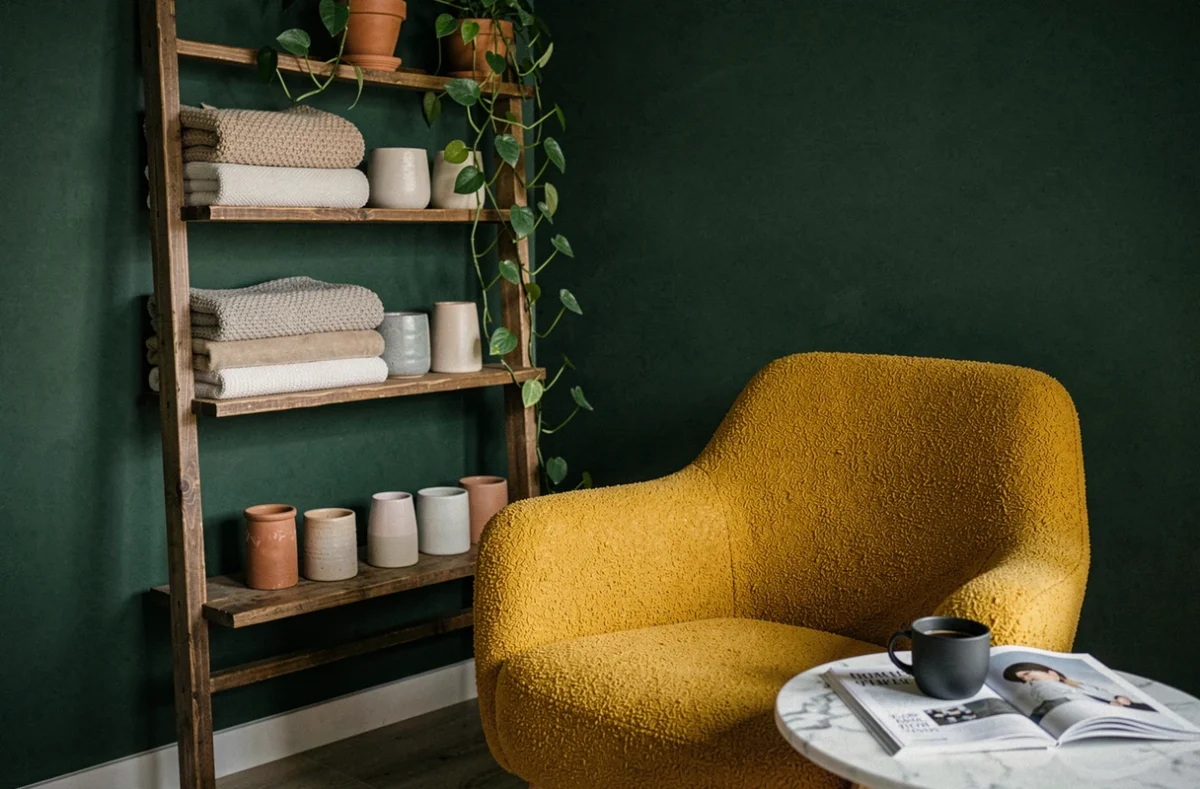
Grouping plants in a single focal point (serving table, ladder shelf, cascading pedestal) creates a mass effect that is much clearer than scattered pots. This plant concentration creates an indoor micro-landscape that structures the gaze.
- Vary the growth habits: trailing (pothos), upright (snake plant), bushy (Boston fern) to generate volume.
- Harmonize the containers: a single material (raw terracotta, glazed stoneware) unifies the whole.
- Place the group near an indirect light source to limit pot rotations.
10. Heavy-textured textiles to anchor a living room
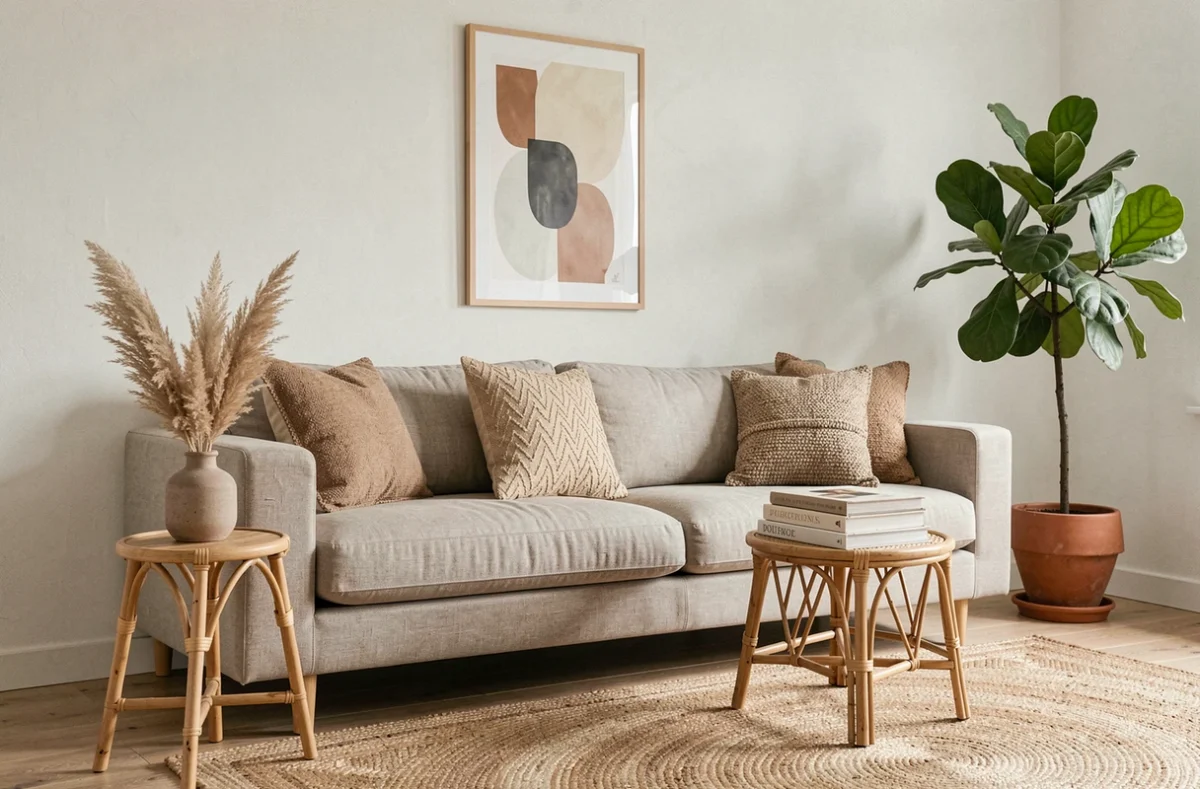
A boucle wool throw, a thick braided jute rug, washed linen curtains with a heavy drape: these dense-weight textiles provide a visual grounding that fine fabrics do not offer. They also absorb some sound, contributing to overall acoustic comfort.
The choice of weight determines durability over time. A too-light linen wrinkles and loses its drape in a few weeks. We favor tight weaves, even if it means reducing the number of textile pieces to stay within a controlled budget.
Each of these ideas works alone, but their combination creates a cumulative effect. A raw earth plaster combined with cork panels and removable furniture produces a coherent interior from a technical standpoint, not just decorative. The sustainable transformation of an interior relies on choices of materials and structure, not on the accumulation of accessories.