
When preparing a floor, a terrace, or a framework, two pieces of wood consistently appear in the plans: the joist and the bearer. Their shapes are similar, their sections sometimes too, and confusion quickly sets in on the construction site. However, their functions within the structure are radically different, and mistaking one for the other can compromise the integrity of the entire work.
Why confusing joists and bearers poses a real structural problem
Imagine a building: the beams support the floors, and the tiles rest on a screed. No one would confuse the beam with the screed. For wood, it’s the same principle. The joist is the horizontal beam that carries the weight of the floor or roof. The bearer is the intermediate piece, lighter, on which the covering (decking boards, parquet) is directly fixed.
Using a bearer where a joist is needed means asking an undersized piece to support loads it cannot handle. The risk ranges from simple sagging of the floor to the complete failure of the framework. Understanding the difference between joists and bearers before purchasing your materials avoids this type of costly mistake.
Wood joist: load-bearing role and sizing according to Eurocode 5
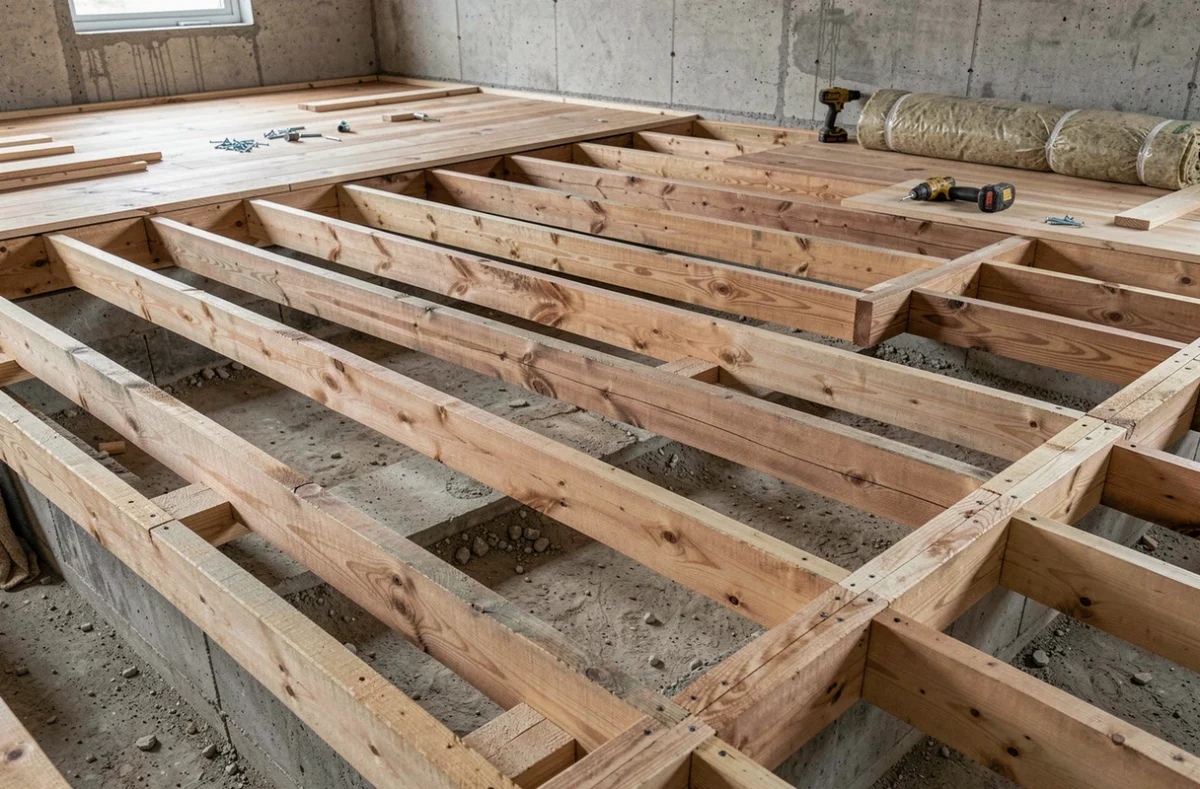
The joist is a piece of wood with a rectangular section, placed on edge (the height is greater than the width). It rests at its ends on beams or load-bearing walls. Its role is to transmit the loads from the floor to the vertical structure of the building.
The joist supports everything above it: the dead weight of the floor, furniture, occupants, partitions. It is the key piece of the joisting system.
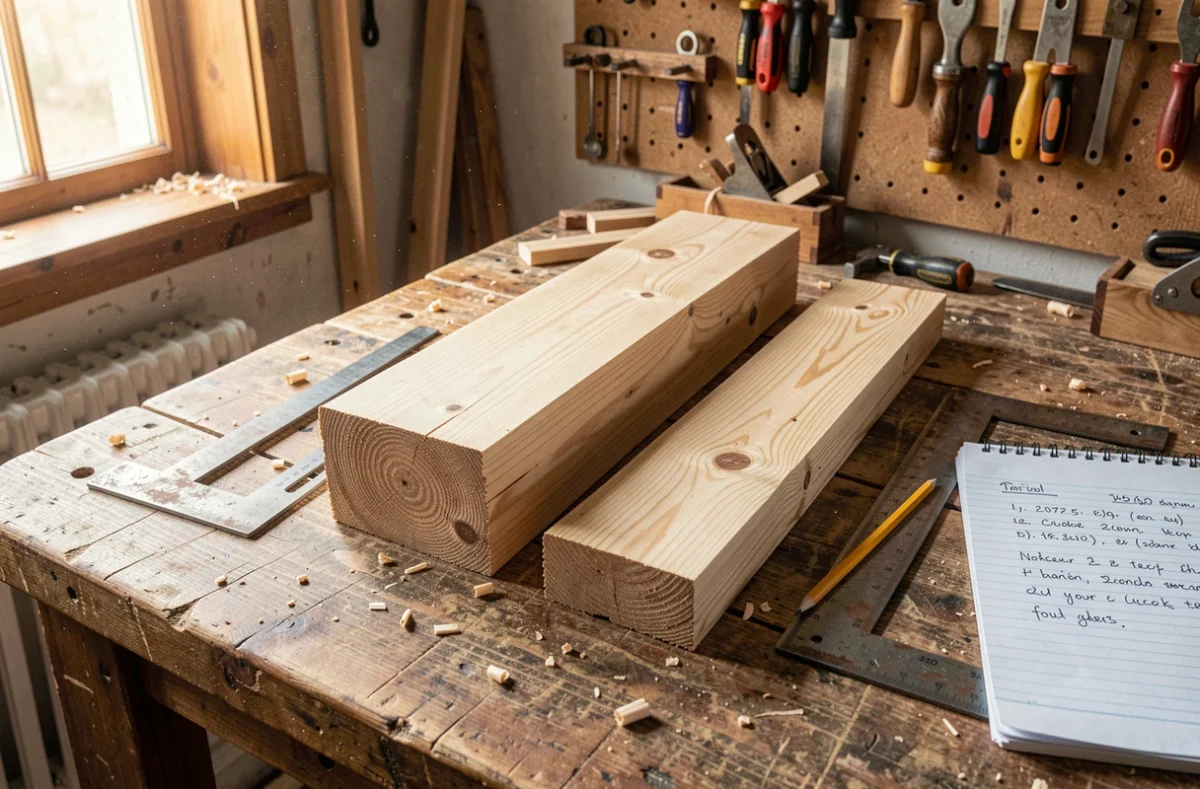
Wondering how to choose the right section? The sizing of a joist cannot be guessed by eye. It depends on several combined parameters:
- The clear span between the two supports (the larger it is, the larger the section must be)
- The spacing between the joists, that is, the distance from center to center between two consecutive joists
- The permanent loads (weight of the floor, coverings) and the live loads (people, furniture)
- The strength class of the wood used, which varies according to the species and treatment
These parameters are checked together according to Eurocode 5 (NF EN 1995-1-1). A joist for a residential floor is not chosen like a piece of equivalent section for a terrace. The calculation constraints differ entirely.
Deflection, a criterion often more restrictive than failure
A floor may appear solid without ever breaking, but sagging visibly or annoyingly. This deformation, called deflection, is often the criterion that requires increasing the joist section even before the failure resistance is reached.
The deformation limit retained for a standard floor is generally around L/300 (L being the span). And deflection increases significantly with the span, as it depends on the span to the fourth power. Doubling the span multiplies the deflection by sixteen, not by two. That’s why joist sections increase so quickly when the piece gets larger.
Wood bearer: support for fixing the covering
The bearer is a thinner piece of wood, with a section significantly smaller than that of a joist. It does not support the structure. Its role is to receive and fix the final covering: wooden decking boards, solid parquet, flooring.
On a terrace, bearers are laid perpendicular to the boards, which are themselves screwed or clipped on top. Indoors, they serve as a support for nailing solid parquet. The bearer distributes point loads to the joists or slab, but it never replaces the load-bearing framework.
Double bearing at the ends of boards
When two decking boards meet end to end, each end must rest on its own bearer. This technique, called double bearing, serves two simultaneous purposes: ensuring a reliable fixing of each board and facilitating water drainage between the two pieces of wood.
This arrangement is recommended in the context of the guidelines associated with NF DTU 51.4, even if it is not systematically mandatory in all configurations. In practice, the absence of double bearing at the ends accelerates the rotting of the ends of the boards.
Wood use class: a choice related to exposure, not to the name of the piece
A common reflex is to think that a framing joist and a terrace bearer fall under the same use class because they are both made of wood. The reality is more nuanced.
The use class is determined by the actual exposure to moisture, not by the function of the piece. A bearer placed close to the ground, in prolonged contact with moisture or without sufficient ventilation, may require a use class 4. Conversely, a joist protected under a roof, sheltered from the elements, often falls under class 2.
Here’s how to distinguish common situations:
- Interior floor joist, in a dry and ventilated environment: use class 1 or 2
- Covered terrace joist but exposed to water splashes: minimum class 3
- Outdoor terrace bearer placed on pedestals, close to the ground: class 3 or 4 depending on ventilation
- Bearer in direct contact with the ground or a water retention: class 4
Choosing a class that is too low to save on the price of wood significantly shortens the lifespan of the construction. The extra cost of suitable wood remains marginal compared to the cost of premature replacement of the framework.
Remember this simple logic: the joist carries, the bearer fixes. The former is sized by mechanical calculation, the latter adapts to the covering and the chosen spacing. Their common point is that both require wood whose use class corresponds to their actual exposure on the site, not to their name in the catalog.