You are moving a heavy piece of furniture upstairs and, halfway up the stairs, a step creaks louder than usual. The question arises: how much weight can your staircase actually bear without risk? The answer depends less on the visible material than on the hidden structure underneath, and confusion on this topic is common.
Structural load of the staircase and floor load: two limits not to be confused
When talking about the weight supported by a staircase, two distinct things are often mixed up. The first is the inherent strength of the staircase: treads, stringers, and risers. The second is the capacity of the support on which the staircase rests (concrete slab, wooden floor, load-bearing wall).
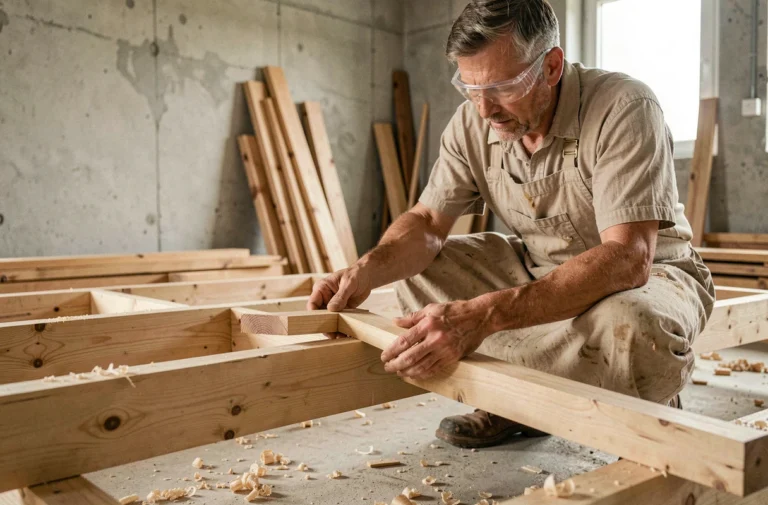
Feedback from maintenance workers and insurers converges on one surprising point: most incidents do not come from the staircase itself. They originate from an undersized floor or anchorage. A perfectly assembled solid oak staircase can collapse if the joists supporting it are rotted or too far apart.
Before asking how much your load weighs, check what your staircase is resting on. A prior structural diagnosis (condition of the joists, quality of the wall anchorage, strength of the masonry) remains the only reliable way to assess the situation, especially if you plan to add a permanent load like a stairlift maximum weight on Octroi Immobilier details common thresholds based on configurations.
Eurocode 1 and usage categories: how stair loads are calculated
Engineers do not size a staircase randomly. The European reference Eurocode 1 (EN 1991-1-1) sets minimum live loads for staircases, classified by building usage category. This classification ranges from category A (residential) to category E (storage areas).
In practical terms, a single-family home staircase is not designed to withstand the same load as an office or public building staircase. Two types of loads are involved in the calculation:
- The uniformly distributed load, expressed in kilonewtons per square meter, simulates the weight of several people moving simultaneously on the treads.
- The concentrated load, applied over a small area, represents a localized impact, for example, a person carrying a heavy object placed on a single step.
- The self-weight of the staircase (its permanent mass), which adds to the live loads to size the stringers and anchorage.
Did you notice that these values vary according to the building’s use? This is why a residential staircase reaches its limit much faster than an industrial staircase, even if they look similar visually.
Stair material and load capacity: wood, concrete, metal
The material plays a direct role in strength, but not in the way one might often think.
A cast-in-place concrete staircase offers the best overall rigidity. Its significant mass makes it less sensitive to vibrations. It tolerates high loads without noticeable deformation. However, its capacity depends on the steel reinforcement embedded in the concrete and the quality of the initial formwork.
A solid wood staircase (oak, beech) can support substantial loads if the assembly is well done. The weak point often lies at the level of the wall encasements and the thickness of the stringers. A stringer that is too thin or poorly fixed becomes the weak link, regardless of the strength of the treads.
Steel and metal offer an excellent strength-to-weight ratio. Metal staircases handle concentrated loads well. Their limit comes more from corrosion (outdoor staircases) or welding, which can create fragile zones if the work is poorly executed.

Warning signs: when your staircase approaches its limit
You don’t need a study office to spot the first signals. Some visible or audible signs deserve a quick reaction.
- Unusual creaking under normal load (one person) indicates weakening of the joints or wood.
- A step that visibly flexes when stepped on signals undersizing or degradation of the material.
- Cracks in the wall at the stringer anchorage points reveal a problem with load transmission to the masonry.
- A handrail that moves laterally betrays fatigued fixings, especially on older staircases.
If any of these symptoms appear, caution dictates limiting the load on the staircase and calling in a professional. A simple reinforcement of the anchorage or a doubling of the stringer may be enough to restore a proper safety margin.
Adding equipment to the staircase: precautions to take
Installing a stairlift, a hoist rail, or even a simple storage unit fixed to the treads adds a permanent load. This load adds to the daily use (passage of occupants, transport of objects).
A structural diagnosis before installation is the most cost-effective precaution. It covers checking the joists under the opening, the condition of the load-bearing walls receiving the fixings, and the compatibility between the weight of the device (with its user) and the residual strength of the staircase.
For a stairlift, manufacturers announce load capacities that pertain to their device, not your staircase. A straight model generally supports more than a curved model due to the distribution of forces along the rail. Some manufacturers offer overload kits to increase the limit, but this never exempts checking that the supporting structure can handle the excess.
The strength of a staircase is not found on a label. It results from a combination: material, assembly, anchorage, support, and overall condition. Having these parameters checked before adding a significant load remains the simplest action to avoid a costly, and sometimes dangerous, incident.