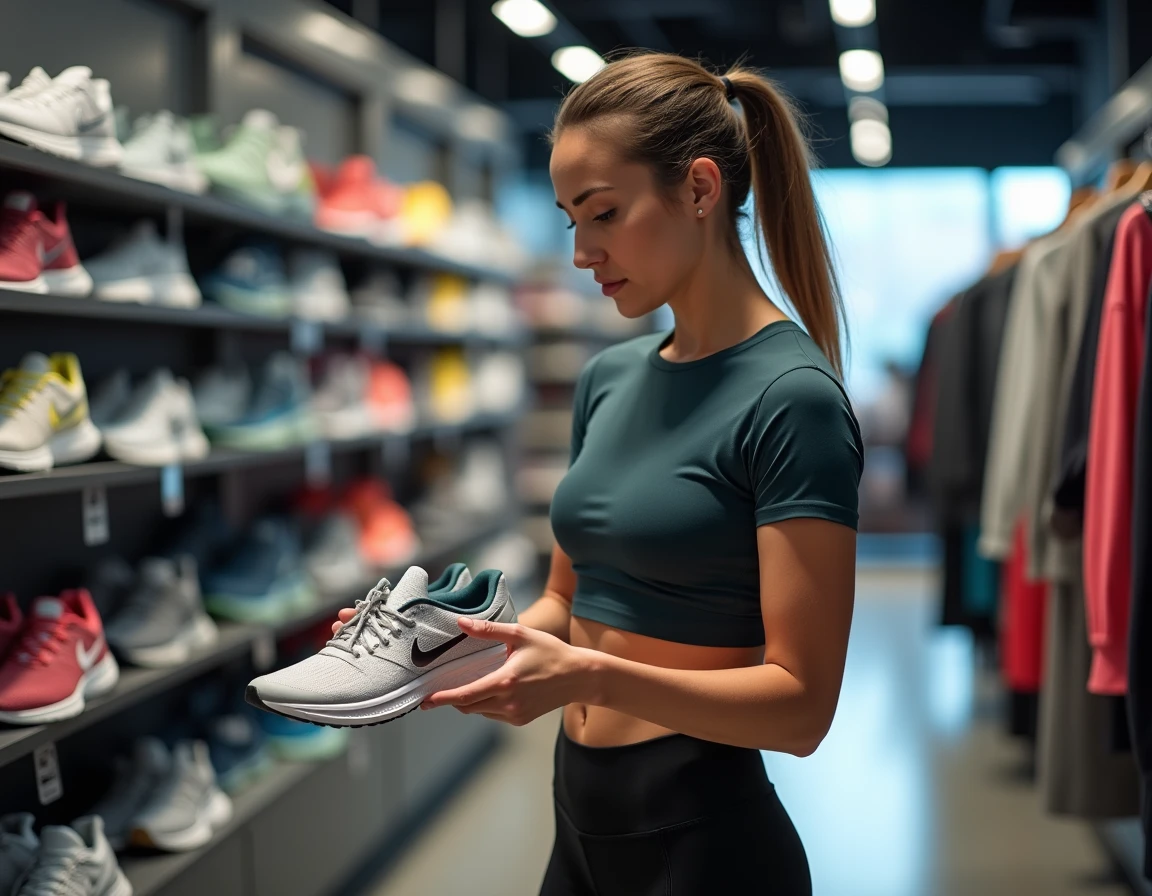
The market for women’s sports equipment has long operated on a simple principle: offering men’s models in smaller sizes and different colors. In recent years, ranges designed from the outset for women’s body shapes and physiological needs have gradually replaced this logic.
Choosing sports equipment as an active woman is no longer just a matter of size or style, but involves technical criteria related to body shape, stride, and comfort during exertion.
Women’s sports equipment: what “women-specific” design changes
Several manufacturers of shoes, smartwatches, and sports headphones now offer products calibrated to female anatomical data. Shoes incorporate widths at the forefoot, drops, and foam densities suited to statistically different strides. Sports watches coming out in 2025-2026 feature more compact cases, bands designed for slender wrists, and, importantly, training algorithms that take the menstrual cycle into account.
This distinction is not cosmetic. A running bra whose support structure has been calculated for repeated high-frequency impact does not protect in the same way as a resized generic model. Similarly, headphones with a band calibrated for a smaller head circumference prevent migraines after an hour of running.
To delve deeper into these technical criteria by discipline, the equipment on Carnet de Sportive details the specifics to check before each purchase.
Menstrual cycle tracking and smartwatches: a central selection criterion
Field feedback varies on the exact reliability of sensors, but the trend is clear: cycle tracking and associated symptoms are now standard features in sports watches designed for women. Several recent models offer training recommendations adjusted to hormonal phases, modulating the suggested intensity according to the time of the cycle.
This criterion transforms the selection grid for a watch. Where the choice was primarily based on battery life, GPS accuracy, and heart rate tracking, female health tracking has become a major selection argument. Some brands go further by integrating modules related to pregnancy, postpartum, or perimenopause.
The available data does not allow for conclusions about the medical accuracy of these tools. They remain indicators, not certified health devices. However, their practical utility for adjusting daily training load seems to be widely agreed upon among regular users.
Technical materials and fit: the real criteria for choosing sportswear
The textile composition of an outfit directly affects comfort during exertion. Quick-drying synthetic fibers (polyester, nylon, spandex) dominate the market for a simple reason: they wick moisture and limit friction much better than cotton. Fabrics with antimicrobial properties also reduce odors during prolonged sessions.
The fit deserves special attention. Leggings that are too tight at the waist compress the digestive organs during cardio exertion. A top that is too loose can get caught in equipment or weight bars. The criteria to check before buying an outfit include:
- The width of the elastic waistband of the leggings, which should hold without compressing, especially when sitting or bending
- The presence of flatlock seams in friction areas (crotch, armpits, bra edges)
- The actual level of compression of the garment, suitable for the activity: light compression for yoga, firmer for running or crossfit
- The length and fit of the top, snug enough not to hinder movement but loose enough to breathe
The size of bras varies from brand to brand, sometimes significantly. Trying on in-store remains the most reliable method, particularly for high-impact activities like running or interval training.
Women’s sports shoes: stride, terrain, and wear
Shoes account for the majority of purchasing errors. Choosing a pair based on design or the popularity of a model often leads to joint pain or overuse injuries. The type of stride (pronated, supinated, or neutral) determines the suitable model, and this information is not always known to buyers.
Some concrete guidelines to help with the choice include:
- A running shoe should be replaced after a certain mileage, which varies depending on the runner’s weight and the type of terrain. The cushioning felt at the foot is not a reliable indicator of the actual wear of the midsole
- For indoor training (fitness, weightlifting, HIIT), a shoe with a flat and stable sole provides better grounding than a running shoe, whose high drop destabilizes lateral support
- Trail runners need traction and protection at the forefoot that are absent in road models, even high-end ones
Unlike clothing, where versatility is possible, a versatile shoe does not really exist in sports. Each activity stresses the foot differently, and an “all-terrain” model represents a compromise that ultimately affects comfort or leads to injuries.
Eco-responsibility in sports equipment: where is the market now
The trend towards eco-responsibility is gaining traction in the women’s sportswear segment. Recycled polyester, less polluting dyes, second-hand circuits offered by the brands themselves: options are multiplying. Some practitioners now use this criterion as a selection filter on par with price or technicality.
However, real limits remain. A legging made from recycled polyester retains the same microplastic release properties during washing as a legging made from virgin polyester. The durability of a garment, measured by the number of washes before losing elasticity or support, is often a more relevant environmental criterion than the mere origin of the raw material.
Identifying one’s stride in a specialized store, checking the fit of a bra under impact conditions, and carefully reading textile compositions can help eliminate the majority of purchasing errors. These checks take time, but they prevent unnecessary expenses and recurring discomfort.