Concrete is a mineral material that meets the requirements of contemporary architecture for both exterior and interior. Its multiple advantages make it the ideal material for projects that demand quality, integration with existing projects, and harmony between spaces. In this article, we will explore the many possibilities that concrete offers in terms of decorative floors Decorative concrete floors.
Interior decorative concrete
Here are the decorative surface aspects of concrete for individual homes, shops, offices, public buildings, etc…
A lire également : The Different Styles of Decoration
Polished concrete
This process reveals the internal texture of the concrete and thus the color and shape of the aggregates.
It is achieved by successive passes of a polishing machine equipped with abrasive tools on the surface of the cured concrete. The first passes are made with coarse abrasive tools to grind the concrete down several millimeters in thickness. Subsequent passes are performed with increasingly fine grains to polish the surface. After five or six polishing passes, a glossy finish or even a mirror finish is obtained.
A découvrir également : The different styles of wallpaper
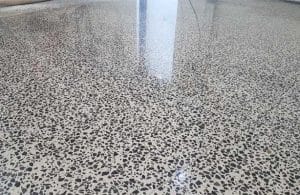 Polished concrete.
Smooth concrete
It is obtained by passing a manual or mechanical trowel (using a concrete helicopter) until a smooth surface is achieved. The concrete can be colored throughout or colored on the surface by sprinkling with a surface hardener dye (stamped concrete).
Waxed concrete
This process is derived from industrial floors. The concrete is poured in place and finished with a helicopter (mechanical heating) with the incorporation of a surface hardener (quartz) that can be colored. The waxed finish is achieved by applying, after curing, a “filling pore” (wax).
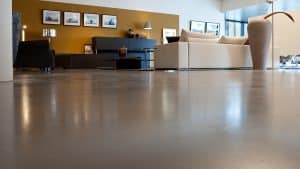 Waxed concrete.
Exterior decorative concrete
Here are the decorative surface aspects of concrete for concrete terraces, driveways, approaches, patios, yards, pool decks, etc…
Exposed aggregate concrete
exposed aggregate concrete, also known as washed concreteexposure, is a decorative concrete obtained by combining a suitable concrete formula enriched with gravel and a special application technique. This involves exposing the gravel by removing the top layer of the surface mortar using a product applied to the surface of the fresh concrete.
This flooring offers excellent value for money/appearance.
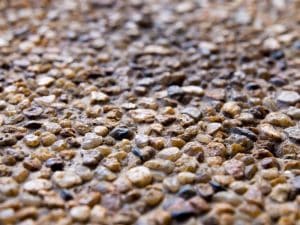 Exposed aggregate concrete.
Stamped concrete with stencils
This process aims to reproduce the appearance of existing materials (cobblestones, stone slabs, etc.) on the surface of the concrete, creating two-dimensional patterns. These patterns are obtained by laying perforated rolls of laminated cardboard forming a “stencil” on the surface of the fresh concrete, then removing them once the concrete has hardened.
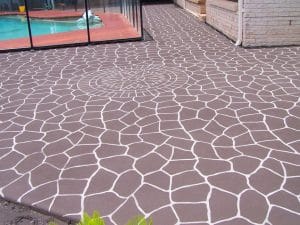 Stamped concrete with stencils.
Stamped concrete
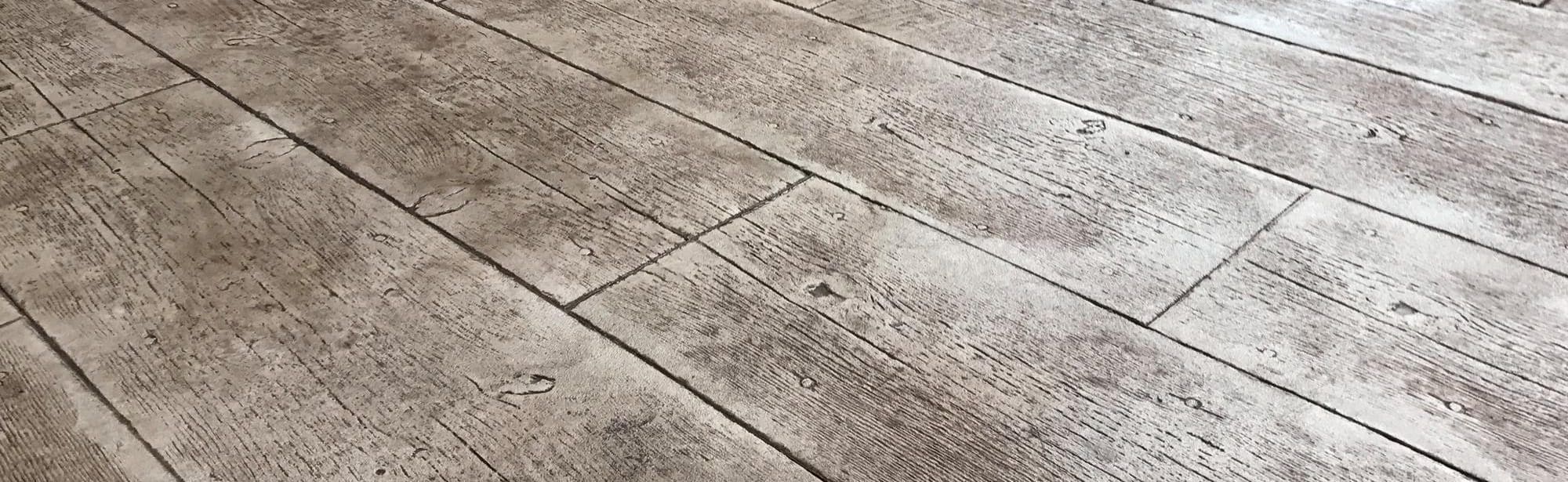
Also known as imprinted concrete, stamped concrete, patterned concrete, the technique involves applying a stamp to the fresh concrete to imprint a raised pattern. This process, which allows for three-dimensional relief effects, should not be confused with stencil-printed concrete.
The choice of stamps is very varied and allows for all types of decor. These stamps, also called molds or matrices, used in combination with colored hardeners and a colored release agent, allow for the imitation of natural materials with deceptive realism such as stones, cobblestones, brick, and wood.
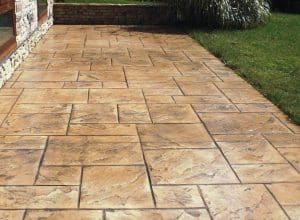 Decorative concrete deck molds.
Broom-finished concrete
Surface state obtained by passing a slurry over cured concrete. This machine is equipped with rollers with carbide tips that hammer the surface of the cured concrete, producing localized spalling. This process reveals the internal texture of the concrete and thus the color and shape of the aggregates.
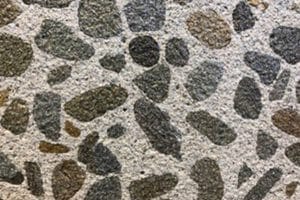 Rock-like appearance in broom-finished concrete.
Sandblasted concrete
Results from the mechanical treatment of hardened concrete by blasting with abrasive materials (sands, silica…). The treatment is preferably done in the presence of water to avoid dust: this is called hydroblasting or hydro-gommage concrete.
Ground concrete
A variant of polished concrete but suitable for outdoor use. The fineness of the grinding is deliberately limited so as not to make the surface too slippery.
Scaled concrete
This finish involves scalping, after curing, the skin of the concrete by a few millimeters using a sander equipped with stripping tools.
This process reveals the internal texture of the concrete and thus the color and shape of the aggregates.
The last aspect is that of rocky flooring.
Smooth concrete
It is obtained by passing a manual or mechanical trowel (surfacing with a concrete helicopter) until a smooth surface is achieved. This finish can be applied to colored concrete throughout or on the surface by sprinkling with a hardener dye.
Troweled concrete
The finish of this concrete, done with a float, is less fine than the smoothed finish; slight movements of the tool can be observed.
Broomed concrete
Decorative concrete whose surface is textured by fine parallel and regular stripesbroom marking, which enhance grip while improving aesthetics. These stripes are made using a specific tool on freshly poured concrete. The regularity and shape of the stripes can vary depending on the desired final appearance.
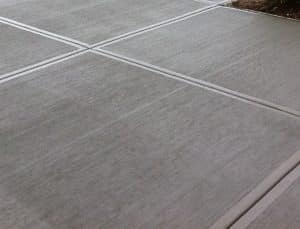 Broomed concrete.
Tag : discover broomed concrete